


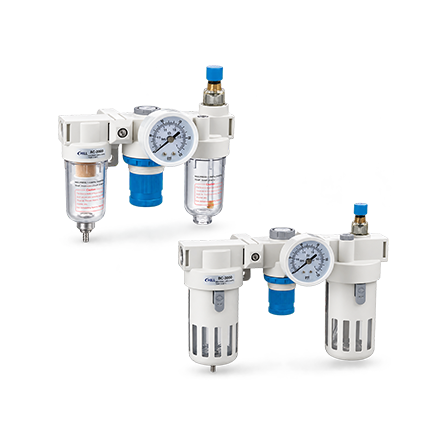
Air Preparation Units (FRL)
Network Industrial supplies air preparation units globally for machine maintenance, new pneumatic assemblies and compressed-air system upgrades. An FRL combines filtration, pressure regulation and lubrication to condition compressed air before it reaches the connected components. The required assembly depends on the incoming air supply and the needs of the equipment downstream.
Air preparation sits between the compressed-air network and the working machine. It helps establish suitable operating conditions at the point of use, where pressure and air quality may differ from conditions at the compressor. Supply enquiries can cover complete assemblies or the specific replacement requirement identified by an existing model reference.
Selecting an FRL involves the airflow needed during the machine cycle, the available inlet pressure and the required outlet setting. Lubrication is included only where the connected equipment requires it.
Description
Description
Industrial Applications
Air preparation units are used on assembly machinery, packaging equipment, pneumatic clamping stations and air-powered workshop tools. They provide a local point for conditioning the supply before air passes into valves, actuators or tools.
On equipment with changing demand, the regulator’s flow performance affects pressure at the working component. This matters when several actuators operate together or a tool draws a high airflow during part of its cycle. The filter must also address the contaminants specified for the application without creating excessive restriction.
Installation environments influence construction requirements. Dust, cleaning chemicals and exposure to impact can affect the suitability of the body, bowl and protective arrangement. The location should also allow normal access to drains, adjustment controls and serviceable components.
Filter Regulation and Lubrication
The filter captures contaminants according to its element and separation capability. A stated particle rating does not establish removal of every form of oil or moisture.
The regulator controls downstream pressure within its operating range. Its response under flowing conditions matters as well as the pressure shown when the equipment is idle.
The lubricator introduces oil for equipment designed to receive lubricated air. Where components are specified for operation without added oil, the preparation arrangement should reflect that requirement. The complete assembly must suit the equipment’s air-quality specification and the maintenance access available at the installation.
Technical Specifications
The assembly’s model determines its ratings. The following details describe the specification needed for a product enquiry.
| Parameter | Specification detail |
|---|---|
| Inlet pressure | Maximum supply pressure and permitted operating range. |
| Regulated pressure | Required outlet setting and adjustment range. |
| Flow capacity | Airflow at stated inlet pressure and permitted pressure drop. |
| Filtration | Particle rating, separation capability and element reference. |
| Connections | Port size, thread standard and direction of airflow. |
| Bowl and drain | Material, protection and drain arrangement. |
| Lubrication | Equipment requirement and specified lubricant where applicable. |
| Environment | Temperature limits and compatibility with surrounding conditions. |
A matching port thread does not establish equivalent flow capacity. Assembly dimensions, mounting centres and clearance beneath the bowl also affect replacement fit, particularly where the unit sits inside a machine enclosure.
Why Source from Network Industrial?
Network Industrial supplies air preparation as part of a wider pneumatic product range. This gives procurement teams a single contact for an enquiry that includes the preparation unit, valves, cylinders and line connections.
The purchasing requirement can be based on the original assembly reference or on the machine’s pressure, flow and air-quality specification. Keeping these details together makes the enquiry more useful than ordering solely by connection size.
FAQs
Does every pneumatic system need a lubricator?
No. Added lubrication depends on the connected equipment. Some components are designed to operate without it.
Can an FRL replace a compressed-air dryer?
An ordinary FRL does not provide the same moisture control as a dryer. The treatment arrangement must meet the application’s specified air quality.
Why does pressure fall when the machine operates?
Flow demand and restriction in the supply circuit can cause a pressure drop. The regulator and assembly capacity need assessment under operating flow.
Request a Quotation
Send the FRL model reference, port size, pressure requirements, filtration specification and quantity. Include a photograph of the complete assembly for replacement enquiries.
Delivery Info
- Standard and Express delivery services are available for all items.
- Shipping costs are calculated at the checkout page (after delivery option & destination confirmation).
- Tracking is available for all delivery options.
- Items are delivered during standard business hours.
Reviews
There are no reviews yet.