


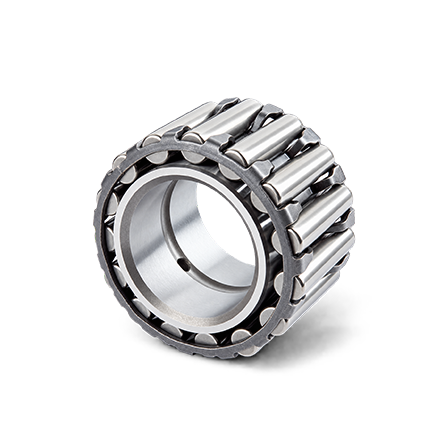
Roller Bearings
Roller bearings carry loads through rolling elements that contact raceways along a line rather than at a single point. Many designs provide substantial radial load capacity, although their allowable speed, alignment and friction characteristics vary. Network Industrial supplies roller bearing requirements globally for industrial machinery maintenance, power transmission and equipment projects.
The term roller bearing covers several different constructions. Cylindrical, tapered, needle and spherical roller types address different forces and shaft movements. This page focuses on general roller bearing requirements, particularly cylindrical roller configurations, while the specialised product families are identified separately.
Description
Description
Industrial Applications
Cylindrical roller bearings are used in gear drives, industrial pumps, compressors and heavy rotating equipment where radial loading is significant. Some designs permit an installed shaft to move slightly along its axis as temperature changes. Others can locate a shaft in a specified direction, depending on the ring construction.
A bearing that runs continuously under high load needs a suitable lubrication supply and heat management. Contaminated or vibrating environments introduce additional sealing and mounting considerations. During maintenance, record whether the original bearing operated as a fixed-end support or a floating support, because changing that function can affect the whole shaft arrangement.
Types and Configuration
Single-row cylindrical roller bearings differ in their ring ribs. Designs in the NU or N families typically permit relative axial displacement, while NJ, NUP and other arrangements can provide defined axial locating functions. The allowed axial loading and movement must be verified for the exact series and installation.
Double-row and multi-row roller bearings serve applications needing particular radial capacity or rigidity. Full-complement variants use additional rollers without a conventional cage in some constructions. Their higher roller count can change load capacity, friction, speed and lubrication requirements, so full-complement is not a universal improvement.
Technical Specifications
Specify the complete manufacturer code, bore diameter, outside diameter and width. Some cylindrical roller bearings are separable. State clearly whether the order is for a complete bearing, an inner ring or another compatible assembly component. Components from unrelated sets must not be mixed without the manufacturer’s interchangeability guidance.
Check static and dynamic radial load ratings, operating speed, lubrication type and expected working temperature against the chosen model. A bearing that can carry a high radial load may still be unsuitable where its rib arrangement prevents required axial movement. Thermal shaft expansion must be addressed by the overall fixed-and-floating bearing layout.
Cylindrical roller bearings can be sensitive to angular misalignment. Distorted housings or incorrectly machined shaft seats may concentrate force near a roller end. Review internal clearance, fits, cage, lubricant and mounting method instead of relying on nominal dimensions to confirm service suitability.
If the original bearing failed prematurely, inspect races, seals and mounting surfaces. Heating could reflect an unsuitable fit, insufficient lubrication or unintended axial constraint. Replacing the bearing with a higher-load version without diagnosing the cause may repeat the same fault.
Why Source from Network Industrial?
Network Industrial supports international roller bearing procurement enquiries from original product designations, equipment drawings and scheduled quantities. Exact requirements help buyers distinguish locating and floating configurations and assess quotations consistently. Alternative references should be technically reviewed for construction, load ratings and operating limitations.
Commercial availability, manufacturer and supporting documentation must be confirmed against each quoted product, not assumed from the overall roller bearing category.
Request a Quotation
Provide bearing code, dimensions, required quantity and machine application. Include operating speed, radial and axial load information, lubricant and delivery destination. Indicate whether the assembly needs a locating or non-locating bearing, especially when requesting an alternative.
FAQs
Can all cylindrical roller bearings carry axial loads?
No. The bearing’s rib design governs its axial locating function; some versions mainly permit axial displacement.
Is full-complement always the preferred design?
No. It may provide greater load capacity but can require different speed and lubrication conditions.
Why might a new roller bearing overheat?
Possible causes include incorrect fits, misalignment, unsuitable lubrication or axial constraint. Inspect the assembly before selecting another replacement.
Delivery Info
- Standard and Express delivery services are available for all items.
- Shipping costs are calculated at the checkout page (after delivery option & destination confirmation).
- Tracking is available for all delivery options.
- Items are delivered during standard business hours.

Reviews
There are no reviews yet.