


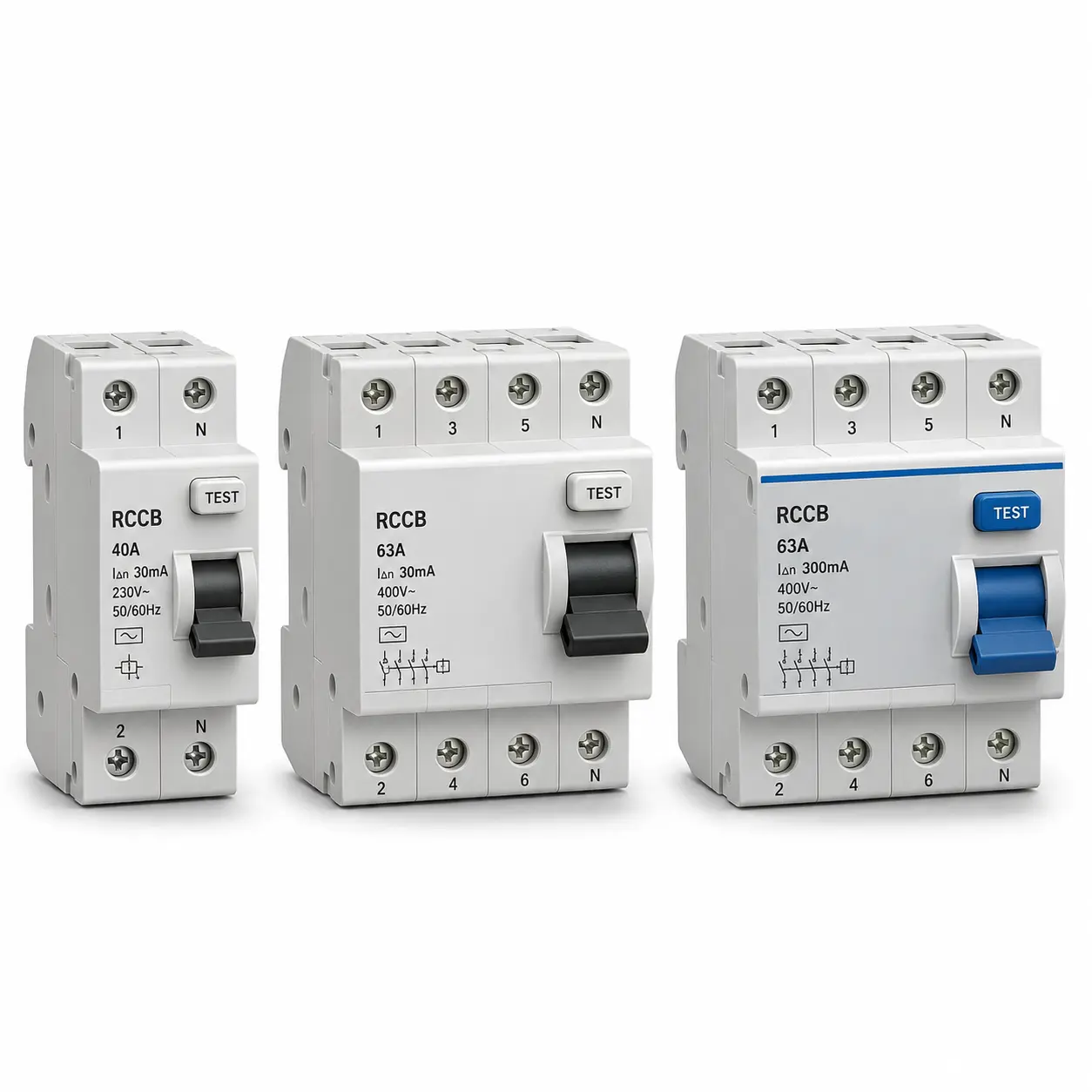
Residual Current Circuit Breakers (RCCBs)
Network Industrial supplies residual current circuit breakers globally for industrial installations requiring residual-current protection. An RCCB monitors the balance of current through the circuit conductors and disconnects the circuit when a qualifying residual current reaches its operating threshold.
RCCBs do not provide overload or short-circuit protection. They must be coordinated with suitable overcurrent protection as part of the installation design. Selecting an RCCB therefore involves both its own ratings and the protective devices and loads around it.
Description
Description
Industrial Applications
RCCBs are used in suitable distribution circuits, equipment supplies and industrial facility installations where residual-current protection is specified. The protection objective, earthing arrangement, load characteristics and applicable installation requirements determine the appropriate device.
Electronic power supplies and inverter-driven equipment can produce residual-current waveforms that differ from a simple sinusoidal AC fault. The specified detection type must suit those waveforms. Existing leakage currents and upstream protection also matter when assessing unwanted tripping and the required selectivity.
Types and Configurations
Type AC, Type A, Type F and Type B describe different residual-current detection capabilities. Type A covers sinusoidal AC and pulsating DC residual currents; Type F addresses specified mixed-frequency conditions associated with certain single-phase inverter loads. Type B includes smooth DC detection within its specified performance.
Choose the type using the equipment manufacturer’s instructions and installation requirements. Instantaneous and time-delayed versions serve different protection arrangements. Two-pole and four-pole configurations are common, but the conductor arrangement and neutral requirements must match the selected model. A higher sensitivity threshold is not a general remedy for unexplained tripping.
Technical Specifications
Rated current and residual-current sensitivity describe different duties. Specify both, along with the associated overcurrent protective device.
| Parameter | Specification detail |
| Rated current | Required current-carrying capability and installation conditions. |
| Residual sensitivity | Specified rated residual operating current, IΔn. |
| Detection type | AC, A, F or B as required by the load and design. |
| Operating supply | Voltage, frequency, poles and neutral arrangement. |
| Time characteristic | Instantaneous or specified delayed/selective operation. |
| Overcurrent coordination | Associated device and conditional short-circuit requirements. |
| Installation details | Mounting, dimensions, terminals and required documentation. |
An RCCB’s rated current indicates its current-carrying capability under specified conditions. It does not mean the device will trip on an overload at that value. Conditional short-circuit performance depends on the manufacturer’s specified coordination with an overcurrent protective device; it should not be confused with a standalone breaker interrupting rating.
Why Source from Network Industrial?
Network Industrial accepts global enquiries for RCCBs and the related electrical products needed within an industrial requirement. Buyers can submit the residual-current device alongside its associated overcurrent protection, panel references and installation documentation.
That combined specification is particularly useful for replacement purchases where an original device is no longer clearly identified. Record the detection type, sensitivity and any time-delay marking as well as the ampere rating. If an alternative is considered, its suitability needs checking against the complete protection arrangement before purchase.
FAQs
- Does an RCCB replace an MCB?
No. An RCCB provides residual-current protection, while an MCB provides overcurrent protection. A suitable coordinated arrangement is needed where both functions are required. - Is Type B the same as a B-curve breaker?
No. RCCB Type B refers to residual-current waveform detection. A B trip curve on an MCB describes its instantaneous overcurrent tripping characteristic. - Does the test button verify the whole installation?
No. It checks the device’s test function as described by its manufacturer. It does not replace installation verification, protective-conductor checks or the prescribed inspection and testing procedures.
Request a Quotation
Send the manufacturer reference, rated current, residual-current sensitivity, detection type, poles and operating voltage. Identify any delay requirement and the associated breaker or fuse. Include load details, quantities, destination and required date; attach clear label photographs for replacement enquiries.
Delivery Info
- Standard and Express delivery services are available for all items.
- Shipping costs are calculated at the checkout page (after delivery option & destination confirmation).
- Tracking is available for all delivery options.
- Items are delivered during standard business hours.
Reviews
There are no reviews yet.